This Property can be understood from the below two examples :-
Example 1 = Below figure represent Triangle PQR
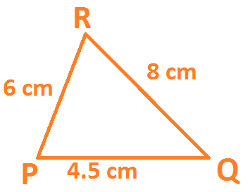
In the above figure, Triangle PQR has
PQ = 4.5 cm
QR = 8 cm
PR = 6 cm
Now Lets, check the property
PQ + QR > PR
4.5 + 8 > 6
12.5 > 6 ----- (True)
QR + PR > PQ
8 + 6 > 4.5
14 > 4.5 ----- (True)
PR + PQ > QR
6 + 4.5 > 8
10.5 > 8 ----- (True)
Hence, it's proved that "Sum of Two Sides of the Triangle is Always Greater than the Third Side."
Example 2 = Below figure represent Triangle ABC
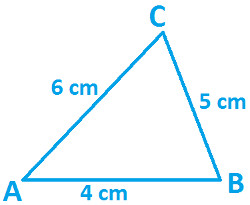
In the above figure, Triangle ABC has
AB = 4 cm
BC = 5 cm
CA = 6 cm
Now Lets, check the property
AB + BC > CA
4 + 5 > 6
9 > 6 ----- (True)
BC + CA > AB
5 + 6 > 4
11 > 4 ----- (True)
CA + AB > BC
6 + 4 > 5
10 > 5 ----- (True)
Hence, it's proved that "Sum of Two Sides of the Triangle is Always Greater than the Third Side."
Similarly, we can check and prove that "The difference of two sides of a triangle is smaller than the third side "
|