| Arithmetic Additive Identity
Arithmetic Progression
Associative Property
Averages
Brackets
Closure Property
Commutative Property
Conversion of Measurement Units
Cube Root
Decimal
Distributivity of Multiplication over Addition
Divisibility Principles
Equality
Exponents
Factors
Fractions
Fundamental Operations
H.C.F / G.C.D
Integers
L.C.M
Multiples
Multiplicative Identity
Multiplicative Inverse
Numbers
Percentages
Profit and Loss
Ratio and Proportion
Simple Interest
Square Root
Unitary Method
Algebra Cartesian System
Order Relation
Polynomials
Probability
Standard Identities & their applications
Transpose
Geometry Basic Geometrical Terms
Circle
Curves
Angles
Define Line, Line Segment and Rays
Non-Collinear Points
Parallelogram
Rectangle
Rhombus
Square
Three dimensional object
Trapezium
Triangle
Quadrilateral
Trigonometry Trigonometry Ratios
Data-Handling Arithmetic Mean
Frequency Distribution Table
Graphs
Median
Mode
Range
Videos
Solved Problems
|
Home >> Percentages >> Define Percentage
Definition
The term Percentage was derived from two Latin Words Per and Centum which means Out of Hundred.
Percentage is denoted by a symbol ' % '.
Percentage compares between the whole and its parts.
Before you understand, how Percentage compare between the whole and its parts; lets understand what is whole and what are its parts ?
Observe the following diagram; illustrating Whole and Its Parts
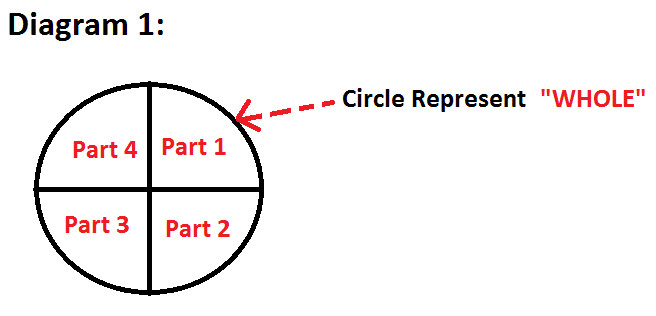
As you can observe in diagram 1:
Whole is represented in the form of Circle.
Part 1, Part 2, Part 3, Part 4 represents different parts of the whole
Or we can also write it as:
Whole Circle = Part 1 + Part 2 + Part 3 + Part 4
This means that sum of all the parts is equal to the whole or we can say that value of whole part is equal to the sum of values of all its part
Now let's understand this whole and its parts from a real life example:
Example: Four friends ordered a pizza. Pizza was divided into four equal portions. And each friend ate one portion.
Now in this situation:
Pizza represents the whole and four portions represent its 4 equal parts.
Now let's understand the significance of Percentage, which helps to find the value of the whole and its parts:
Value of whole part is always 100%
And as explained above, whole part is equal to sum of all parts; so:
This 100% value of whole part in divided into its different parts.
Observe the following diagram 2 & 3:
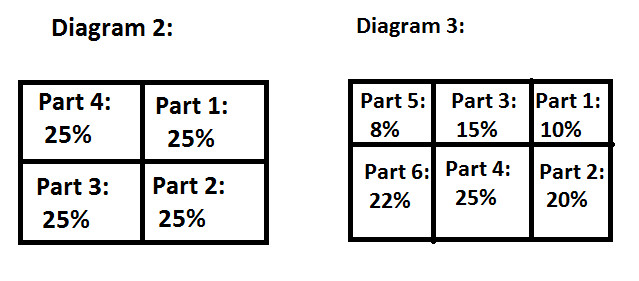
Following are the observation from diagram 2 & 3:
Value of whole in both the diagram is same i.e. 100%
Sum of the values of parts in both the diagram is equal to 100% which is the value of whole
Number of parts of a whole is not definite and it can vary from situation to situation
Values of parts of the whole can be same as well as different also.
Now let's understand this whole and its parts from a real life example:
Example: In a class, there are 60% boys and 40% girls
Now, in this situation:
Class is a whole and boys & girls are its parts.
Also, values of parts i.e. boys and girls are 60% and 40% respectively.
Percentages can be :
Converted to Fractions
Converted to decimals
Explanation of these two topics(with examples) is available in the above links.
|
|